

A02. DHUB Museums
Museu de les Arts Decoratives
History
The origins of the Museu de les Arts Decoratives date back to 1888, when Barcelona closed its Universal Exhibition and the City Council decided to create various historic collections and the museums to house them in. As a result, the Museu de les Arts Decoratives i Arqueològic was created in the old Ciutadella arsenal in 1902, where a wide range of collections were assembled.
However, it was not till 1932 that the Museu de les Arts Decoratives opened at the Palau de Pedralbes, by then finally separated from archaeology and fine arts. The outbreak of the Spanish Civil War brought about the closure of the museum, as well as the transfer of its collections to Olot, where they were guarded during the hostilities to guarantee their protection and safety.
In the post-war period, in 1949, the Palau de la Virreina came to be the new home of the museum, with the exhibitions organised in a similar fashion as they had been in their old home. But this was not to be the permanent venue of the museum, and the Museu de les Arts Decoratives closed its doors here in 1985, as the building had been given a new municipal purpose.
The collections were again returned to the Palau de Pedralbes, where they remained in storage for close to ten years until the museum opened its doors again in 1995, but this time with a very important new addition: the inclusion of a collection of Spanish industrial art.
The permanent exhibition
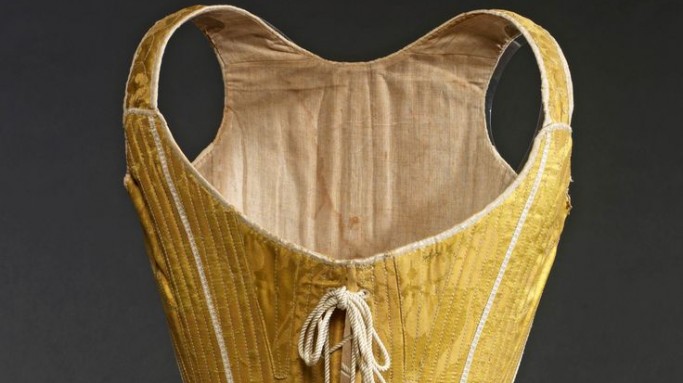
The permanent exhibition of the Museu de les Arts Decoratives, “From the one-off object to product design”, presents a chronological itinerary in two parts. The first part, displaying 297 pieces, shows the evolution of decorative art objects from the Romanesque to Romanticism, and the birth of product design with the Industrial Revolution.
The second part of the itinerary focuses, above all, on the development of product design with an exhibition containing 442 pieces that form a representative sample of industrial design in Spain.
Permanent exhibition Museu Arts Decoratives
Browse the collection
The collections
The collections of the Museu de les Arts Decoratives are based on important resources of industrial design and decorative art objects, among them salvers, carriages, furniture, wallpaper, clocks, tapestries and glasswork. The creation of this collection has been made possible thanks to the financial support of Barcelona City Council and the determination and generosity of a great many donors: from aristocrats, patrons and collectors to businessmen and private citizens.
See further information on the various collections:
Product design
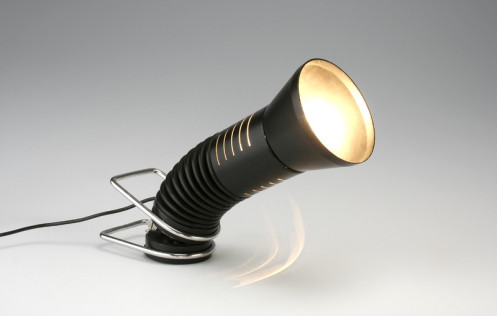
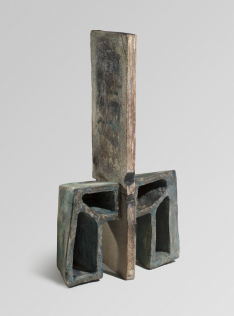
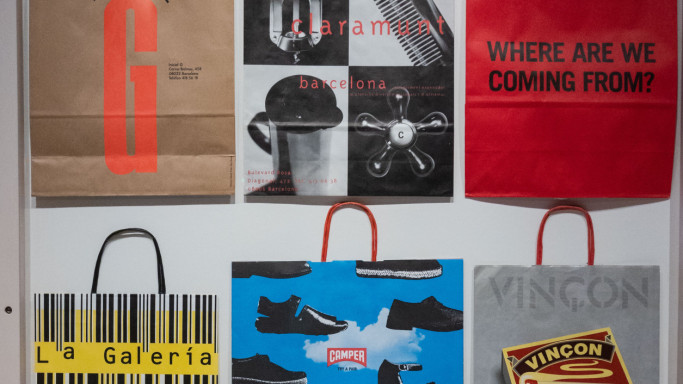
The product design collection, made up of more that 1,400 objects, covers the period of time between the 1930s and the dawn of the 21st century, and contains pieces of Spanish design and/or production representing the wide variety of products to which design is applied.
Stool Dúplex, 1981, Javier Mariscal
Salvers
The collection of salvers – metal platters – is formed by 171 pieces, the great majority of which date from between the 16th and 17th centuries. The pieces in the collection are finished with embossed decorations of vegetal elements and they come mostly from production centres in Germany and the Netherlands.
Church collection plate, 16 th Century, Germany
Carriages
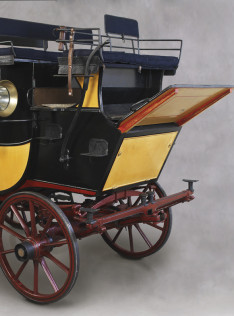
The collection of carriages is formed by a total of 18 vehicles dating from between the mid-18th century and the first quarter of the 20th century. The oldest pieces of the collection come from various seigniorial houses of Barcelona. Also of note are the six carriages which once belonged to the carriage houses of the industrialist Eusebi Bertrand Serra.
Carriage, mid-18 th, Spain
Furniture
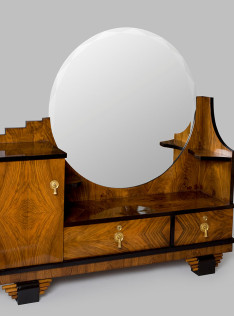
The furniture collection is formed by over 800 pieces of European manufacture representative of the period from the Middle Ages to the 20th century. The collection includes: caskets, trunks, chests of drawers, desks, tables, cornucopia mirrors, screens, dressing tables and chairs. A special place is held by the Gothic and Renaissance marriage chests, the so-called “Olot beds” from the 18th century with polychrome headboards, the historicist furniture by Francesc Vidal, and the lacquered Art Deco pieces by Ramon Sarsanedas and Enriqueta Benigani.
Chest with drawers, mid-16 th, Catalonia
Wallpaper
The wallpaper collection is formed by over 1,300 pieces, including wainscots, borders. corners, friezes and ceiling panels. Their manufacturers were mainly French, English, German, Belgian and Spanish, and they were made from the last quarter of the 19th century to the last quarter of the 20th century.
Painted paper motif. United Kingdom, 1880 - 1890
Clocks
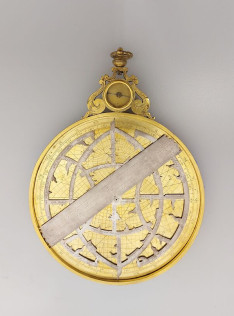
The clock collection is formed by 304 pieces of European origin, which were produced between the 16th and 19th centuries. Notable among them are the portable clocks.
Pocket watch, 1790, Monnier et Mussard
Tapestries
Made up of twenty pieces of which the most notable are The Siege of Rhodes and the Dromedary Caravan and Asian Emigration, which date from the late 15th or early 16th century. The contemporary pieces include the remarkable tapestry Diana the Huntress, produced by Tomàs Aymat and dated around 1925.
Tapestry, late-16th-century, Brussels
Glasswork
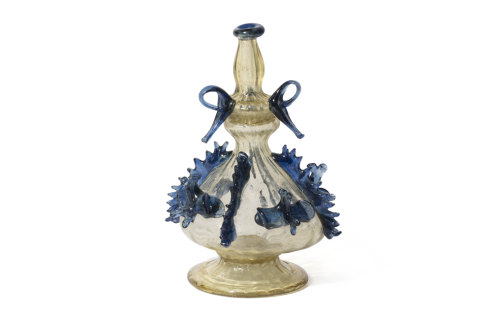
The museum’s glasswork collection includes 1,443 pieces, the oldest of which date from the 6th century AD. Notable among them are the 16th- and 17th-century Venetian pieces and those from the Germanic area, with examples from between the 17th and 19th centuries, made of cut and engraved crystal.
The collection also includes French Art Nouveau. Outstanding among the Spanish pieces are those from the Real Fábrica de la Granja (18th and 19th centuries). Foremost among the Catalan production is an exceptional set of 18 pieces of 16th-century enamelled glass.
Vessel, 1500, Catalonia